
How to Read a Profit & Loss Statement Without an Accounting Background

Most business owners avoid their financial reports.
Not because they do not care about their numbers. But because no one ever taught them how to read them.
A Profit & Loss Statement looks official. It has rows, columns, and accounting terminology that can feel foreign if you did not study finance. So many owners glance at it, feel uncertain, and close the tab.
That is a costly habit.
Your Profit & Loss Statement — also called a P&L or Income Statement — is one of the most useful reports for understanding how your business is performing. And it is far simpler than it looks.
This article walks you through exactly what it is, what each section means, and the three numbers to check every single month.
What Is a Profit & Loss Statement?
A Profit & Loss Statement shows how much money your business brought in, how much it spent, and whether it came out ahead or behind over a specific period of time.
That period might be a month, a quarter, or a full year.
Think of it as your business's report card for a specific period. Not a snapshot of today — a summary of what actually happened over time.
Key Takeaway A Profit & Loss Statement answers one fundamental question: Did my business actually make money during this period?
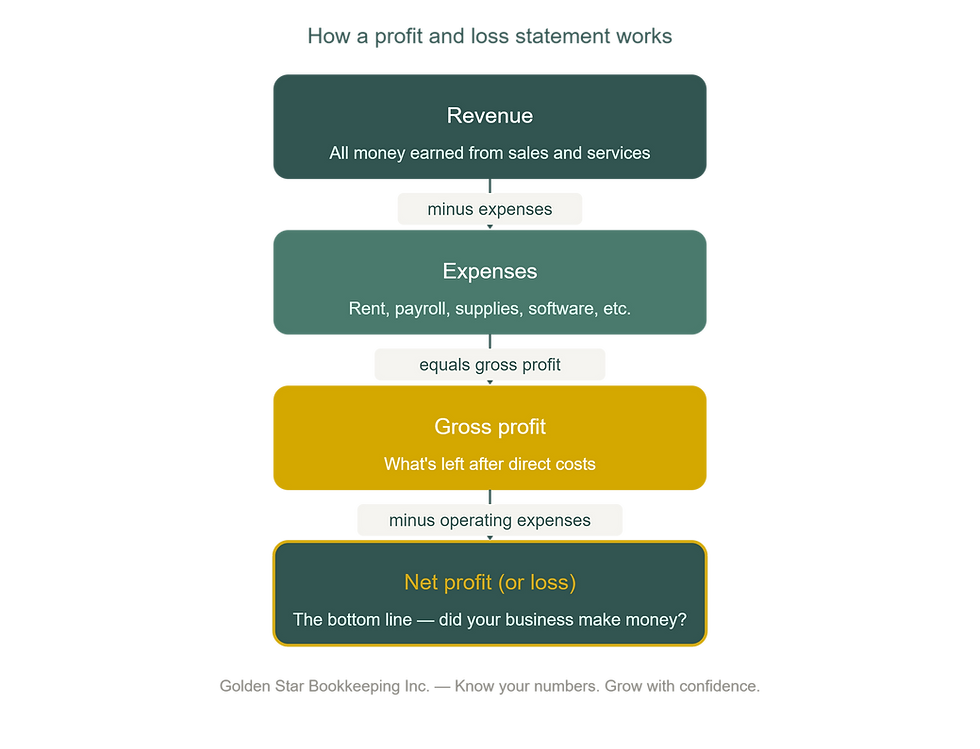
The Five Parts of a Profit & Loss Statement
1. Revenue
Revenue is the total amount your business earned from selling its products or services during the period.
This is the top line — the starting point for everything else.
Important: Revenue is not the same as cash received. If you sent an invoice in March but the client paid in April, that revenue may still appear in March depending on how your books are set up. This is one reason why your bank balance and your P&L do not always match.
2. Cost of Goods Sold (COGS)
Cost of Goods Sold represents the direct costs of delivering your product or service.
For a product-based business, this includes materials and manufacturing costs. For a service-based business, it might include subcontractor fees or direct labour costs tied to specific client work.
Not every business has COGS. Many service businesses — including most bookkeeping clients — have little or no cost of goods sold.
3. Gross Profit
Gross Profit is what remains after subtracting Cost of Goods Sold from Revenue.
Formula: Revenue − Cost of Goods Sold = Gross Profit
This number tells you how much the business earns from its core activity before overhead costs are considered. A healthy Gross Profit margin is essential — it is the foundation everything else is built on.
4. Operating Expenses
Operating Expenses are the costs of running the business that are not directly tied to delivering a specific product or service.
These typically include:
Rent and utilities
Software subscriptions
Marketing and advertising
Insurance
Professional fees (accounting, legal)
Office supplies
Salaries for administrative staff
These costs exist whether you make one sale or one hundred.
5. Net Profit
Net Profit is what remains after all expenses — both Cost of Goods Sold and Operating Expenses — have been subtracted from Revenue.
Formula: Gross Profit − Operating Expenses = Net Profit
This is the bottom line. It is the number that tells you whether your business is genuinely profitable.
A positive number means the business made money during that period. A negative number means it spent more than it earned.
Key Takeaway Net Profit is the number that answers the question every business owner should be asking: After paying for everything it takes to run this business, how much was left over?
A Simple Example
Here is what a basic Profit & Loss Statement might look like for a small service business:
Amount | |
Revenue | $18,500 |
Cost of Goods Sold | ($2,000) |
Gross Profit | $16,500 |
Operating Expenses | ($11,200) |
Net Profit | $5,300 |
This business brought in $18,500, spent $13,200 in total, and kept $5,300. That is a net profit margin of approximately 28% — a healthy result for a small service business.
Three Numbers to Check Every Month
You do not need to analyze every line of your P&L each month. Focus on these three numbers first.
1. Revenue
Is revenue growing, holding steady, or declining compared to the same period last month or last year? Revenue trends tell you whether the business is gaining or losing momentum.
2. Net Profit
Is the business profitable? If yes, is the profit margin improving or shrinking? A business can grow revenue and still lose money if expenses grow faster.
3. Operating Expenses as a Percentage of Revenue
This ratio tells you whether expenses are under control relative to what the business is earning. If revenue grows but this percentage stays flat or decreases, that is a healthy sign. If this percentage is creeping upward, expenses may be getting ahead of the business.
Common Mistakes When Reading a P&L
Confusing Revenue With Profit
Revenue is what you earned. Profit is what you kept. A business with $500,000 in annual revenue can still be unprofitable if expenses exceed that amount.
Ignoring the Trend
A single month's P&L is useful. Six months of P&Ls tells a far more meaningful story. Always look at the trend, not just the snapshot.
Comparing to the Wrong Benchmark
Comparing your numbers to a business in a different industry, at a different stage, or with a different model can be misleading. The most useful benchmark is your own previous performance.
Not Reviewing It at All
This is the most common mistake. A P&L that is never read cannot help you make better decisions. Block 15 minutes per month to review yours — it is one of the highest-return habits a business owner can build.
Final Thoughts
Your Profit & Loss Statement is not a document for accountants. It is a decision-making tool for business owners.
Once you understand what each section means and know the three numbers to check every month, reviewing your P&L stops feeling like homework and starts feeling like actually understanding your business.
You do not need to be fluent in accounting. You just need to be familiar enough with your numbers to know whether things are moving in the right direction.
Continue Learning
Now that you understand your Profit & Loss Statement, learn what a financially healthy business actually looks like:
Curious About Your Financial Health?
Take our free Business Health Scorecard and discover how your business is performing in four critical areas:
✓ Cash Flow & Bookkeeping ✓ Profitability ✓ Tax Readiness ✓ Financial Systems
Know Your Numbers. Grow With Confidence.
© 2026 Golden Star Bookkeeping. All rights reserved.

Comments